Writing a good prompt
What it is
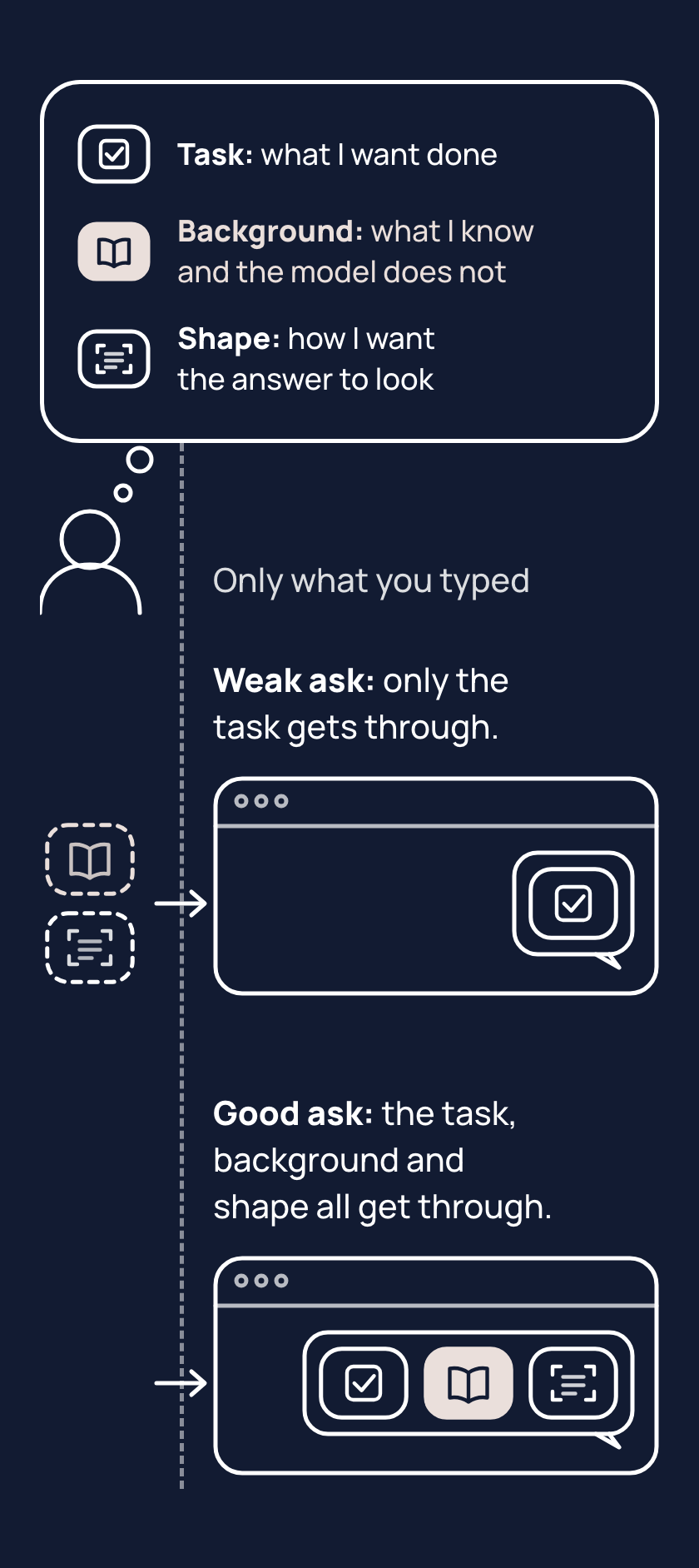
An ask is what you type to your AI app to get something done. The model behind the app knows little about your task beyond what you typed, so a one-line ask leaves the model guessing.
A good ask has three parts. The task is what you want done, starting with a verb. The background is what the model cannot see, such as who the answer is for. The shape of the answer is its length, its form (a list or email) and its tone.
"Write a bio for me" gives only a task. This gives all three: "Write a three-sentence bio for my real estate website. I've sold houses in Geelong for twelve years and I'm known for first-home buyers. Keep it warm, not salesy." Some asks need only the task. Extra words help when they tell the model something it cannot see.
Tips
- Start your ask with a verb for what you want done, because the task tells the model what to make.
- Add one or two lines of background, because the model knows little about your task beyond what you typed and often fills a gap with a guess.
- Say the shape of the answer, such as its length or form, because an answer in the shape you need is one you can use straight away.
Try it
- Pick one real task you want done this week.
- Open a new chat and send your usual one-line ask for the task.
- Open a second new chat and send the same ask with a line of background, such as "It's for my real estate website, and I'm known for first-home buyers."
- In that second chat, also say the shape of the answer you want, such as "Three sentences, warm, not salesy."
- Read both replies and pick the one you could use as it stands.
The reply to the fuller ask often fits your need more closely. If the two replies are alike, your first ask was already enough, perhaps because the task was simple. Two replies to the same ask can differ, so do the steps again if the two replies are close.
Risks
- Background travels with your ask to the company that runs your AI app. Replace names, account numbers and other private details with plain labels, such as "a client".
- Too much extra information can make the answer less helpful. A paragraph of history or a long list of rules the task does not need can pull the answer off course. Keep the task, the background and the shape of the answer, each as short as you can, and cut anything the task does not need.
- A reply that fits your ask can still be wrong, because the model can write a wrong answer in the same tone as a right one. Check any fact before you rely on it.
- If you leave out the shape of the answer, the model chooses one, and you may get an essay when you wanted three lines. Say the length and form you want.
Why it matters
A good ask tells the model what you need. The model can only use what you give it, so when an answer comes back generic, check which part you left out.